Tennis / court commute
Wilson tennis backpack 25–32 L with a counted 1- or 2-racket sleeve, 600D body, padded panel. Shoe garage is optional. Not a framed hike.
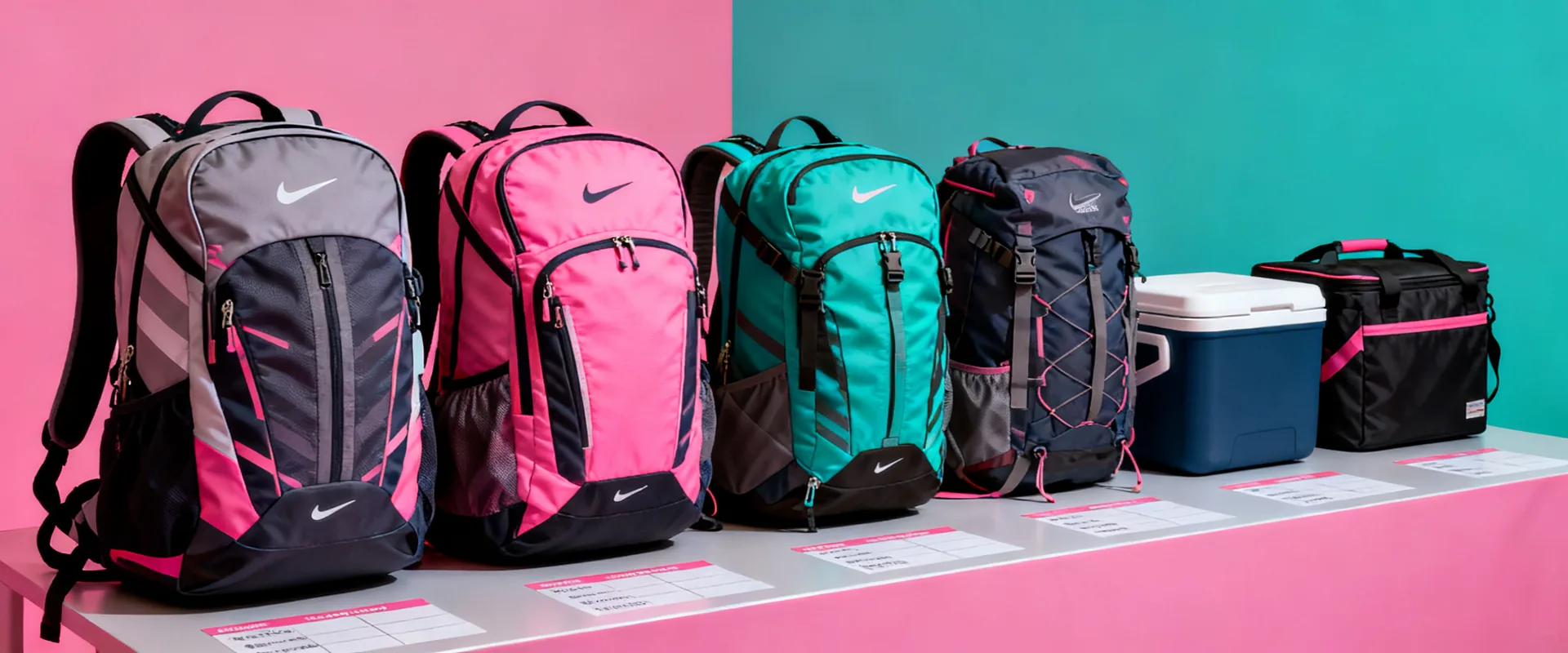
Eight carry jobs. Each has a litre band, a denier default and a rain-film rule. Wilson will not hide a court/trail conflict inside one silhouette. Horizontal cards below are the line-card map; the carousel is how those jobs showed up in recent pack-out tickets.
Scroll the row on desktop. Each card names a litre band and a construction rule. Apparel jerseys and footwear are out of this map even when a club buyer sends them in the same RFQ.
Wilson tennis backpack 25–32 L with a counted 1- or 2-racket sleeve, 600D body, padded panel. Shoe garage is optional. Not a framed hike.
50–70 L, 420D ripstop, alloy stays, hip belt. Loads above about 12 kg. Court sleeves stay off this chassis so the framesheet can sit flat.
Travel backpacks 35–45 L and weekender duffels 40–90 L. Lockable zippers. Airline days, not trail stays. Compression straps are named on the BOM.
8–18 L vests or slim packs with a bladder sleeve. Reservoir litres are named as 1.5 / 2 / 3 L TPU. Court bodies without a sleeve are not hydration SKUs.
Soft cooler bags 12–30 L with a welded liner. Ice-hold is a planning window on the ticket, not an unlimited cold claim. Duffel geometry is not a cooler wall.
Daypacks 20–30 L, 210D or 420D, simpler airflow channel. Laptop sleeves are optional. They do not inherit overnight hip-belt geometry.
Numbered tennis backpacks and court duffels for club-team pack-out. Marks are sampled on production denier. Character art stays out unless licensed.
Stock-wholesale freezes the chassis at 200 pcs. Private-label OEM opens marks at 500 pcs per colorway. Litre class and sleeve count still freeze first.
These notes are typical application stories, not named testimonials. Each one records a construction conflict a buyer actually had to resolve before the PO could freeze.
The industry still argues laminated waterproof membranes against DWR plus PU coating. A DWR+PU tennis backpack can shed a shower and still wet out on a long walk from the parking lot. A laminated film raises hydrostatic head and stiffness. If the brief needs a dry pocket, Wilson names millimetres. If it only needs DWR, the hangtag stays in the water-resistant column.
Stock-wholesale versus private-label OEM is a second fork. Stock freezes the chassis, denier and sleeve count so replenishment matches the last carton. OEM may change logo, colorway and hangtag, but a torso-length or sleeve-count change is a new sample. Denier versus abrasion is a third fork: 210D saves mass on hydration shells; 600D survives locker-room scrape. Swapping denier without restarting the zipper-tape check is how bartacks fail in the field.
Limits we will put in the quote: DWR plus PU coating is not a dry-bag; laminated films add stiffness; a one-size foam pad is not a torso-length harness; a padded pocket is not a racket sleeve; cooler ice-hold is a planning window, not an unlimited claim. Sample methods are zipper cycle, bartack pull, hydrostatic-head check and loaded torso-board; they are not a published third-party round-robin dataset.
Name court, trail, hydration, travel or cooler with litres, denier and whether the path is stock or OEM. The desk will not invent a hybrid silhouette to close a ticket.